
Free tool
Companion planting checker
Thinking of growing two crops side by side? Pick them below to see whether they help each other, are best kept apart, or make no real difference. It covers 26 common UK veg, herbs and flowers.
Choose two crops to see the result.
A quick honest note: companion planting is traditional gardening wisdom. A few pairings are backed by research, but for many the evidence is mixed, so treat it as a helpful extra rather than a guarantee.
Good companions
Pairings that can help each other, whether by confusing pests, bringing in helpful insects or sharing space well.
| Crop | Neighbour | Why |
|---|---|---|
| Carrots | Onions | The strong smell of onions can help hide carrots from carrot fly. The evidence is mixed, but they take up little room and don't compete much. |
| Carrots | Leeks | Leeks can help confuse carrot fly with their smell, and the two grow happily side by side in the same bed. |
| Carrots | Chives | Chives can help mask the smell of carrots from carrot fly, and their flowers bring in pollinators. |
| Carrots | Radish | Radishes come up fast and mark the row while slow carrots get going. You pull the radishes long before the carrots need the space. |
| Parsnips | Radish | Parsnips are slow to come up, so a few radish seeds in the same row show you where they are. The radishes are out of the way within weeks. |
| Lettuce | Radish | Both are quick, shallow crops that fit in the gaps between slower veg, so you get more from the same space. |
| Tomatoes | French marigolds | French marigolds can help keep whitefly off tomatoes, especially in a greenhouse. This is one of the better studied pairings. |
| Tomatoes | Basil | They like the same warm, sunny spot and regular watering. Claims that basil improves flavour or keeps pests off are mostly traditional. |
| Tomatoes | Nasturtiums | Nasturtiums can act as a sacrificial plant, drawing aphids away from tomatoes. Check them often and remove badly hit leaves. |
| Tomatoes | Calendula (pot marigold) | Calendula flowers attract hoverflies, and their larvae eat aphids. It can help keep aphid numbers down nearby. |
| Tomatoes | Borage | Borage flowers are loved by bees, which helps with pollination around tomatoes grown outdoors. |
| Beans (broad, French and runner) | Sweetcorn | Part of the traditional three sisters. Climbing beans can use the corn stalks as support, though in the UK it's safer to give them canes too. |
| Sweetcorn | Courgettes and squash | Another three sisters pairing. The big squash leaves shade the soil, which helps hold moisture and smother weeds under the corn. |
| Beans (broad, French and runner) | Courgettes and squash | The third part of the three sisters. Beans climb while squash spreads along the ground, so they share the space well. |
| Beans (broad, French and runner) | Nasturtiums | Nasturtiums can draw blackfly away from broad and runner beans. Treat them as a decoy and pull them out if they get covered. |
| Beans (broad, French and runner) | Calendula (pot marigold) | Calendula attracts hoverflies and ladybirds, which feed on the aphids and blackfly that bother beans. |
| Brassicas (cabbage, kale, broccoli, sprouts) | Nasturtiums | Cabbage white butterflies often lay their eggs on nasturtiums instead, so they can help as a decoy. Still net your brassicas. |
| Brassicas (cabbage, kale, broccoli, sprouts) | Dill | Dill flowers attract hoverflies and tiny parasitic wasps that help control aphids and caterpillars on brassicas. |
| Brassicas (cabbage, kale, broccoli, sprouts) | Mint | Mint is traditionally grown near brassicas to put off flea beetle and cabbage white. The evidence is mixed, and always keep mint in a pot or it takes over. |
| Strawberries | Borage | Borage brings in bees, which helps strawberry flowers set more fruit. It self-seeds, so pull out spare seedlings. |
| Courgettes and squash | Nasturtiums | Nasturtiums attract pollinators and can draw aphids away from courgettes and squash. |
| Courgettes and squash | Borage | Courgettes and squash need insects to pollinate them, and borage is one of the best bee plants you can grow. |
| Courgettes and squash | Calendula (pot marigold) | Calendula brings in bees and hoverflies, which helps with pollination and keeping aphids down. |
| Lettuce | Calendula (pot marigold) | Calendula can help attract hoverflies whose larvae eat the aphids that like lettuce. |
| Spinach | Radish | Both are quick, cool-season crops that don't compete much, so you can sow them close together. |
| Chard | Beans (broad, French and runner) | Climbing beans don't take much ground space, and chard grows well at their feet in partial shade. |
Keep apart
Pairings that share diseases, compete hard, or are traditionally kept away from each other.
| Crop | Neighbour | Why |
|---|---|---|
| Potatoes | Tomatoes | They're close relatives and both get blight. Growing them together makes it easier for blight to spread from one to the other. |
| Strawberries | Potatoes | Both can get verticillium wilt, a soil disease. Avoid planting strawberries next to potatoes or where potatoes have recently grown. |
| Strawberries | Tomatoes | Tomatoes can carry verticillium wilt, which also hits strawberries. Keep them apart and don't plant one where the other has just been. |
| Onions | Peas | Onions are traditionally kept away from peas because they're said to hold back their growth. The evidence is thin, but it's widely followed. |
| Onions | Beans (broad, French and runner) | Onions and the rest of the onion family are traditionally kept away from beans, which many growers find do less well beside them. |
| Garlic | Peas | Garlic is traditionally kept away from peas because it's thought to stunt them. It's gardening lore more than proven fact, but easy to follow. |
| Garlic | Beans (broad, French and runner) | Like onions, garlic is traditionally kept away from beans. Many growers report weaker bean plants next to it. |
| Leeks | Peas | Leeks belong to the onion family, which is traditionally kept away from peas. |
| Leeks | Beans (broad, French and runner) | Leeks belong to the onion family, which is traditionally kept away from beans. |
| Carrots | Dill | They're close relatives that share pests, and mature dill is often said to hold carrots back. Keep flowering dill elsewhere in the plot. |
| Carrots | Parsnips | Both are hit by carrot fly and the same root problems, so growing them side by side gives pests one big target. |
| Potatoes | Courgettes and squash | Both are hungry, sprawling crops that compete hard for water, food and space. Give each its own bed. |
Any pairing not listed has no strong, widely agreed effect either way.
Companion planting questions
What is companion planting?
Companion planting means growing certain plants near each other because they're thought to help one another, for example by confusing pests, attracting helpful insects or making better use of space.
Does companion planting actually work?
Some pairings have decent backing, such as French marigolds helping keep whitefly off greenhouse tomatoes, and flowers like calendula bringing in hoverflies that eat aphids. Many others are traditional gardening wisdom with mixed evidence, so treat them as a bonus rather than a guarantee.
What should you not plant next to tomatoes?
Keep tomatoes away from potatoes, because both get blight and it spreads easily between them. Strawberries are best kept apart too, as both can suffer from verticillium wilt.
What grows well with carrots?
Onions, leeks and chives are traditional companions because their smell can help hide carrots from carrot fly. Radishes are handy in the same row because they come up fast and are pulled before the carrots need the room.
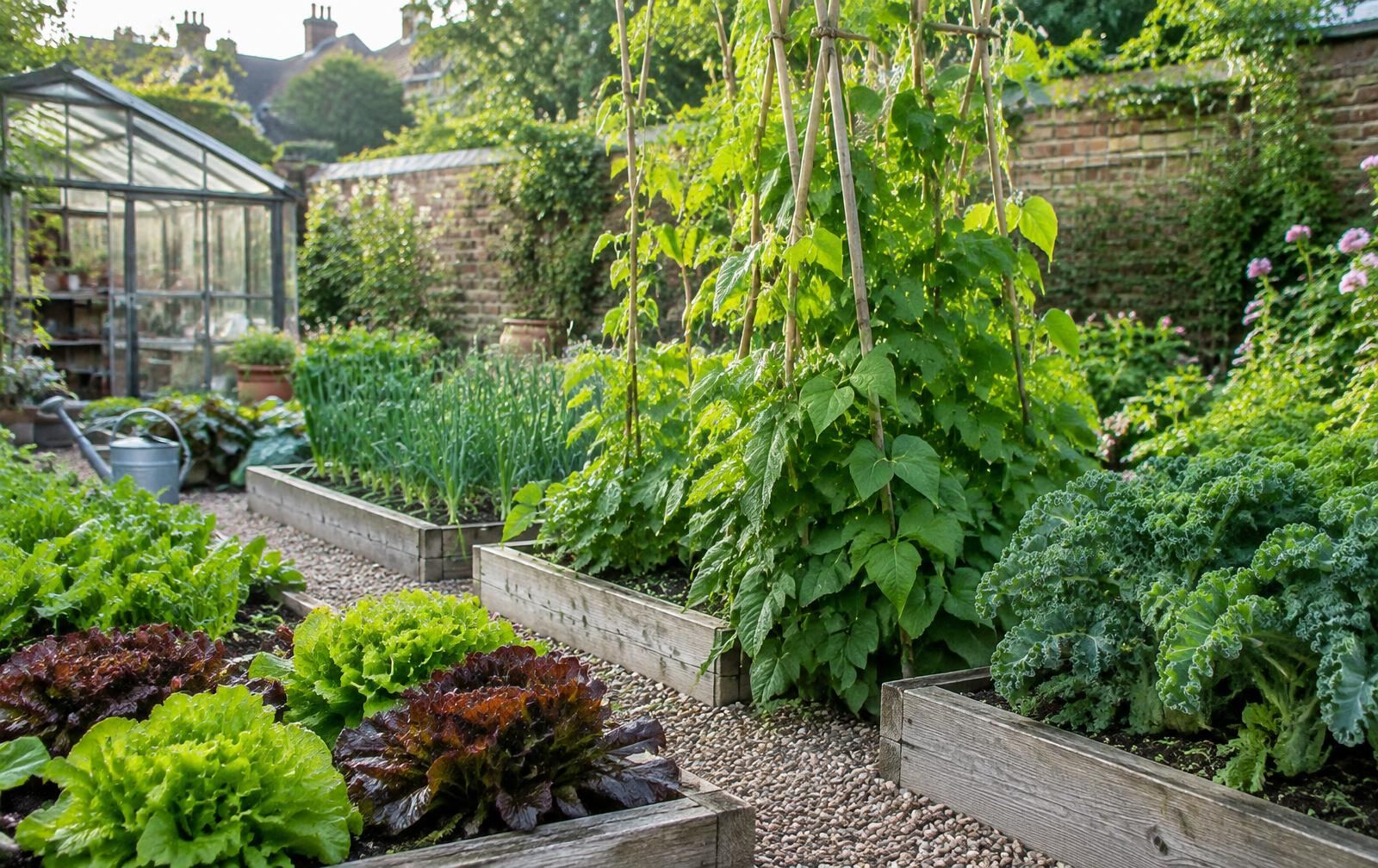
Planning what goes where? The free planting calendar shows when to sow each crop, and the garden planner works out how many fit in your space.
Want the full plan? See the guides.